

International conference
Secularization:
Jewish and Islamic Perspectives
November 13–14, 2024
Salle des Actes, École normale supérieure, Paris
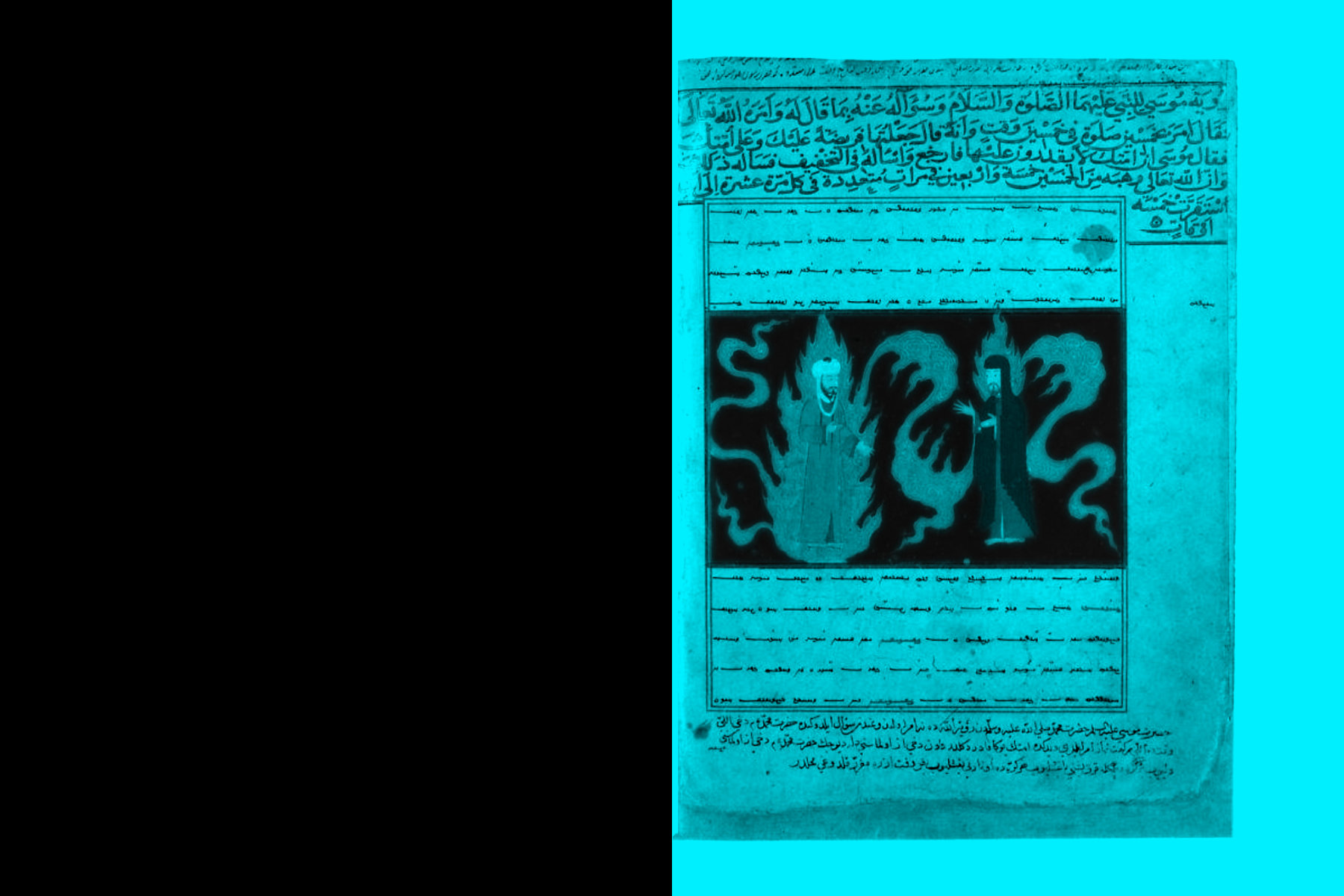
Muhammad and Moses, miniature from the Book of Ascension, Arabic manuscript, Turkey 15th Century CC 4.0 via Wikisource
Secularization: Jewish and Islamic Perspectives
November 13–14, 2024
Salle des Actes, École normale supérieure, Paris
The idea of secularization remains a key to understanding the relationship between modern politics and religion. But it is in a specific way that this idea engages the three monotheistic religions. If it’s true that the political discourse of modernity has been written on the space cleared by the withdrawal of Christianity, as if on a palimpsest, then Judaism and Islam have each developed different, but comparable, relationships with this discourse.
Within each tradition, these relationships have taken different paradigmatic forms, ranging between theological-political resistance to the political discourse of secularization and its fundamental concepts, as (post-)Christian, on the one hand; and on the other hand, mimetic but differential attempts to conceive of Jewish or Islamic secularizations, as alternatives to the political discourse of Christian secularization.
Secular political discourse, Christianity, Judaism and Islam: this rectangular configuration seems to structure, to a large extent, national, regional or international situations and debates, both in the West and in the Near and Middle East. So much so, that it should be asked whether what is presented today as a conflict between civilizations within a Christian, Jewish and Muslim framework is not a conflict of different models of secularization.
Our colloquium will examine the discourses, histories and theories concerning Jewish and Islamic secularization in their complex relations to Christian and post-Christian constellations; the aspects or particularities of each; and the sources of their conflicts. With this in mind, the presentations will address the main concepts involved in the theological-political face-off, such as the state, nationalism, law, community, messianism and so on.
Organisation
Anoush Ganjipour (CNRS-ENS)
Elad Lapidot (University of Lille/The Berlin Center for Intellectual Diaspora)
Cooperation



Programme
| 13 novembre – Matinée | (Salle des Actes) |
| 9:30 | Anoush Ganjipour et Elad Lapidot: Introduction |
| 10:00–10:45 | Nilufer Göle: « Présence musulmane et héritage juif: défis et évolutions du sécularisme européen » |
| 10:45–11:30 | Schirin Amir-Moazami: “Muslims in Europe under secular governance” |
| 11:30–11:45 | Pause |
| 11:45–12:30 | Hamza Esmili: « L’oubli du théologico-politique: Talal Asad et le sécularisme » |
| 12:30–14:30 | Déjeuner |
| 13 novembre – Après-midi | (Salle des Actes) |
| 14:30–15:15 | Sarah Hammerschlag: “Homeopathy or Apotropaeon: Two models of Postwar Jewish Secular Identity” |
| 15:15–16:00 | Elad Lapidot: “Political Theology of the Secular Jewish State” |
| 16:00–16:15 | Pause |
| 16:15–17:00 | Gil Anidjar: “De Inmicii” |
| 17:00–17:45 | Aziz al-Azmeh: “Actually existing secularism and the sociology of fate” |
| 14 novembre – Matinée | (Salle Jean-Paul Sartre – Pavillon Pasteur, étage -1) |
| 9:30–10:15 | Dror Yinon: “Towards a Phenomenology of Jewish Secular Identity” |
| 10:15–11:00 | Atalia Omer. “ ‘Jewish’ Israeli Politics as a Judeo-Christian Civilizational Secularism: The Israeli ‘Judicial Coup’ in the Context of the American Neoconservative Reconfiguration of Racialized Religious Politics” |
| 11:00–11:15 | Pause |
| 11:15–12:00 | Luca Di Blasi: “Multiple Postsecularities” |
| 12:00–14:00 | Déjeuner |
| 14 novembre – Après-midi | (Salle des Actes) |
| 14:00–14:45 | Anoush Ganjipour: « La naissance de la souveraineté en islam: une histoire (contre-)séculière » |
| 14:45–15:30 | Chowra Makaremi: « Résistance féministe au pouvoir théocratique en Iran: la question de l’antagonisme » |
| 15:30–16:00 | Pause |
| 16:00–18:00 | Table ronde: Nilufer Göle, Jean-Claude Monod, Anoush Ganjipour: « Sécularité, société et intégration » |
Participants
© ceu.edu
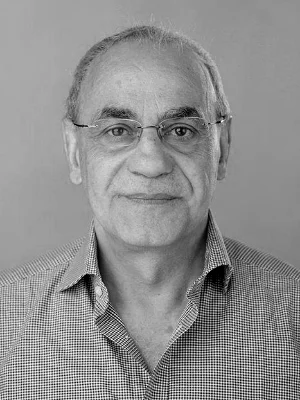
Aziz Al-Azmeh is University Professor emeritus at the Central European University, Vienna. He has been a long-term fellow of the the Institute for Advanced Study, Berlin, and was twice Directeur de Recherches Associé at the Maison des Sciences de l’Homme, Paris (Bourse Fernand Braudel). He was a fellow at the institutes for advanced study in Uppsala and Budapest, a fellow of the Alexander von Humboldt foundation, a fellow of the Käte Hamburger Kolleg, and a resident scholar at the Rockefeller Foundation Center for Scholars in Bellagio. He held the Chaire Averroes at the Mediterranean Institute for Advanced Research in Marseille. He has held visiting professorships at Columbia, Yale, Berkeley, Georgetown, the Institut d’Etudes Politiques, Paris, and the Aga Khan University’s Institute for the Study of Muslim Civilisations.
Among his books in English are Secularism in the Arab World (Edinburgh, 2020), The Emergence of Islam in Late Antiquity (Cambridge, 2014), The Arabs and Islam in Late Antiquity: A Critique of Approaches to Arabic Sources (2014), Islams and Modernities (London, 2009), Muslim Kingship (London, 1996), and Arabic Thought and Islamic Societies (London, 1986).
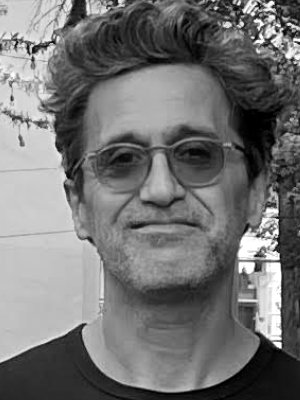
Gil Anidjar teaches in the Department of Religion and the Department of Middle Eastern, South Asian, and African Studies at Columbia University. His main contributions to the political theology debates are found in The Jew, the Arab: A History of the Enemy (Stanford UP, 2003) and in Blood: A Critique of Christianity (Columbia UP, 2014).
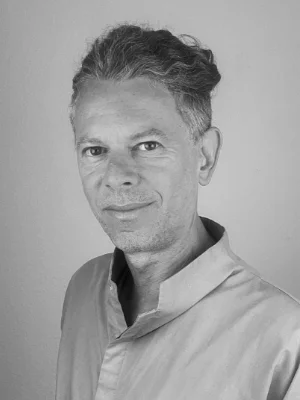
Luca Di Blasi is Associate Professor of Philosophy at the Theological Faculty of the University of Bern, and Associate Member of the ICI Berlin. His theoretical main interests include philosophy of religion, modern continental philosophy, postsecularism, and political theology. Main publications: Politik der Schuld, (Mathes & Seitz), 2025 (forthcoming); Dezentrierungen. Beiträge zur Religion der Philosophie im 20. Jahrhundert (Vienna: Turia+Kant, 2018); Der weiße Mann. Ein Anti-Manifest (Bielefeld: transcript, 2013); Der Geist in der Revolte. Der Gnostizismus und seine Wiederkehr in der Postmoderne (Munich: Fink, 2002).
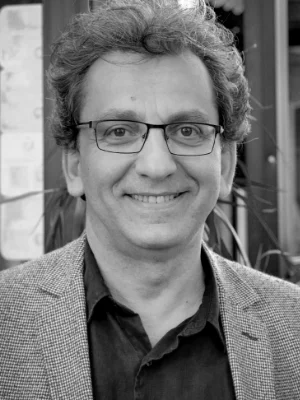
Frédéric Brahami est directeur d’étude de l’EHESS (CESPRA – UMR 8036). Il travaille actuellement sur les fondements philosophiques du républicanisme et du socialisme français, autour notamment des figures de Jaurès, Péguy et Bergson.
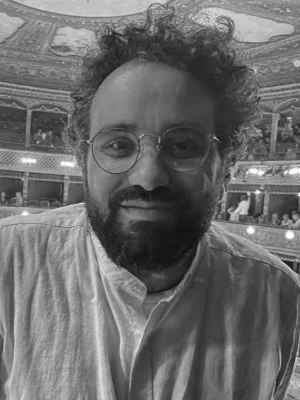
Hamza Esmili
Anthropologue de l’islam, Hamza Esmili s’intéresse aux aspirations théologico-politiques se découvrant en situation de crise collective, en particulier au sein des sociétés maghrébines et des communautés issues de l’immigration postcoloniale en Europe. Il entame une recherche au long cours sur les formes de millénarisme et de messianisme au Maghreb à l’heure coloniale. Son projet consiste ainsi à interroger depuis cette perspective singulière les caractérisations concurrentes du salut au sein de la tradition islamique contemporaine, ainsi que leurs transformations successives parmi les États-nations postcoloniaux.
Sa thèse, “La fidélité et son reste”, parait au Seuil en 2025.
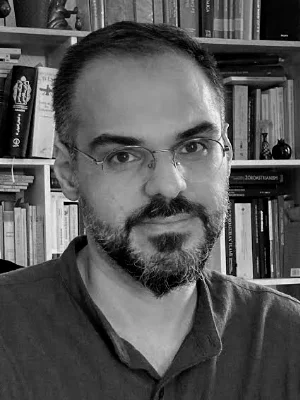
Anoush Ganjipour is a permanent researcher on philosophy at the Centre National de Recherche Scientifique (Centre Jean Pépin-École Normale Supérieure, Paris). He is a specialist in Islamic thought and comparative philosophy.
Among his books are Israël, la Palestine et nous (co-authored with Jean-Claude Milner, Cerf, 2025 [forthcoming]), Monothéismes et politique: modernité, sécularisation, émancipation (CNRS Éditions, 2022) and L’ambivalence politique de l’islam: pasteur ou Léviathan? (Seuil, 2021).
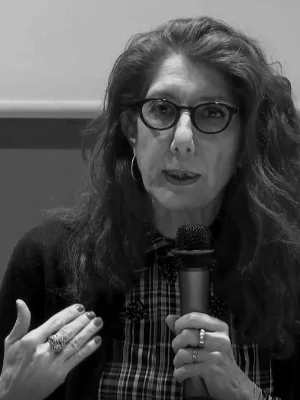
Nilüfer Göle is a professor of sociology at CESPRA at the École des Hautes Études en Sciences Sociales (EHESS) in Paris. Her research centers on the public sphere, the intersections between secularism and religion, and multiple modernities.
Her work particularly explores how Muslim visibilities are negotiated in the European public sphere, making her a key figure in contemporary debates on multiculturalism, integration, and religious pluralism in Europe. She currently leads the AgorAkademi – Creative Inquiry for Public Space project, supported by the NOMIS Foundation, at Columbia Global Paris Center.
Her recent publications include Musulmans au quotidien. Une enquête européenne sur les controverses autour de l’islam (La Découverte, Paris, 2015), Public Space Democracy. Performative, Visual and Normative Dimensions of Politics in a Global Age (ed. Routledge, 2022), and Revendiquer l’espace public (with Richard Rechtman, Yves Cohen, and Sandra Laugier, CNRS Editions, 2022).
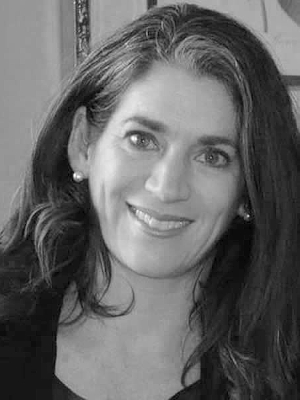
Sarah Hammerschlag is Professor for Religion and Literature at the University of Chicago. Her research thus far has focused on the position of Judaism in the post-World War II French intellectual scene, a field that puts her at the crossroads of numerous disciplines and scholarly approaches including philosophy, literary studies, and intellectual history.
She is the author of The Figural Jew: Politics and Identity in Postwar French Thought (University of Chicago Press, 2010) and Broken Tablets: Levinas, Derrida and the Literary Afterlife of Religion(Columbia University Press, 2016) and the editor of Modern French Jewish Thought: Writings on Religion and Politics (Brandeis University Press, 2018)
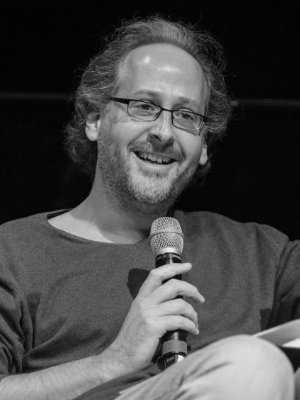
© Ruthe-Zuntz
Elad Lapidot is professor for Culture Studies at the University of Lille, France. He specializes in philosophy, Jewish thought and Talmud and was teaching at the University of Bern, Switzerland, the Humboldt Universität Berlin and the Freie Universität Berlin. His work is guided by questions concerning the relation between knowledge and politics. Among his publications: Jews Out of the Question. A Critique of Anti-Anti-Semitism (SUNY Press, 2020), Hebrew translation with introduction and commentary of Hegel’s Phänomenologie des Geistes, Vol. 1 (Resling, 2020), Heidegger and Jewish Thought. Difficult Others, (Rowman & Littlefield, 2018), and Etre sans mot dire : La logiqe de ‘Sein und Zeit’ (Zeta Books, 2010).
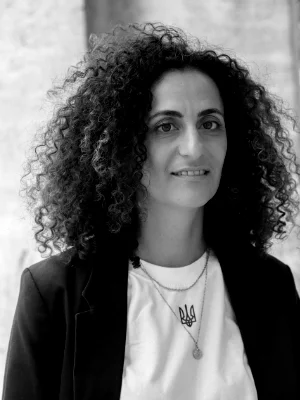
Chowra Makaremi est anthropologue au CNRS à Paris, affiliée au Laboratoire d’Anthropologie Politique à l’EHESS. Elle a coordonné plusieurs collectifs de recherche sur le contrôle des frontières en Europe. Elle a aussi publié, sur la révolution iranienne, Le cahier d’Aziz. Au coeur de la révolution iranienne (Gallimard, 2011) et avec Hannah Darabi Rue Enghelab. Une révolution par les livres 1979-83 (Le Bal/Spector, 2019). Elle a réalisé le film Hitch. Une histoire iranienne (Alter Ego, France, 78 min., 2019). En septembre 2023, elle publie Femme ! Vie ! Liberté ! Echos d’un soulèvement révolutionnaire en Iran (La Découverte, Prix de l’essai Arte/France Culture 2023).
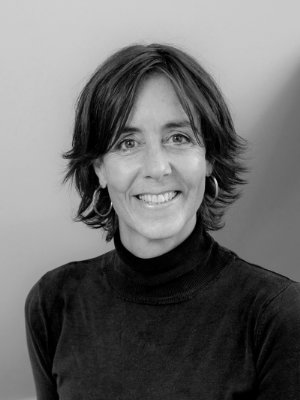
Schirin Amir-Moazami is Professor of Islam in Europe at the Institute of Islamic studies at Freie Universität Berlin. She studied Political Sciences and Sociology in Frankfurt/Main, Berlin, Aix-Marseille and Paris. She holds a PhD from the European University Institute in Florence, Department of Social and Political Sciences.
Schirin Amir-Moazami published widely on topics related to Muslims in Europe, especially Germany and France, with a focus on political secularism, the politics of knowledge production, body politics and governmentality. She is the editor of the volume “Der inspizierte Muslim. Zur Politisierung der Islamforschung in Europa” with transcript and the author of the monograph: „Interrogating Muslims. The Liberal-Secular Matrix of Integration” that will be published with Bloomsbury Press in spring 2022
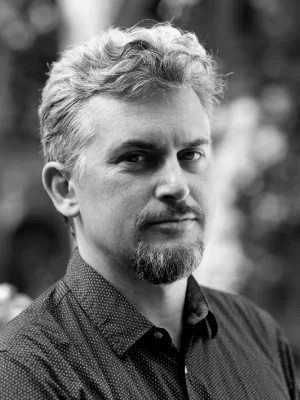
Jean-Claude Monod est philosophe et directeur de recherche au CNRS. Ses travaux portent sur la philosophie allemande post-hégélienne, en particulier sur la question des rapports entre politique et religion(s), les interprétations de la modernité et, plus généralement, la philosophie politique contemporaine. Il est notamment auteur de la Querelle de la sécularisation, de Hegel à Blumenberg (Vrin, 2002), Penser l’ennemi, affronter l’exception. Réflexions critiques sur l’actualité de Carl Schmitt (La Découverte, 2006), Qu’est-ce qu’un chef en démocratie? (Seuil, 2012) et L’art de ne pas être trop gouverné (Seuil, 2019).
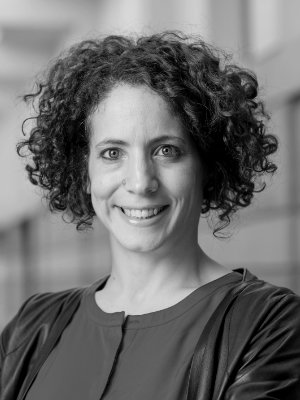
Atalia Omer is a Religion, Conflict, and Peace Studies Professor at the Kroc Institute for International Peace Studies and the Keough School of Global Affairs at the University of Notre Dame. She also recently served as a senior fellow and Dermot TJ Dunphy Visiting Professor at the Religion, Conflict, and Peace Initiative at Harvard University’s Religion and Public Life program. She earned her PhD in Religion, Ethics, and Politics (2008) from the Committee on the Study of Religion at Harvard University. Her research focuses on religion, violence, and peacebuilding, as well as theories and methods in the study of religion. Omer was awarded an Andrew Carnegie Fellowship in 2017, resulting in Decolonizing Religion and Peacebuilding (Oxford University Press, 2023). Among other publications, Omer is the author of When Peace is Not Enough: How the Israeli Peace Camp Thinks about Religion, Nationalism, and Justice (University of Chicago Press, 2015) and Days of Awe: Reimagining Jewishness in Solidarity with Palestinians (University of Chicago Press, 2019). She is also a co-editor of the Oxford Handbook of Religion, Conflict, and Peacebuilding (Oxford University Press, 2015).
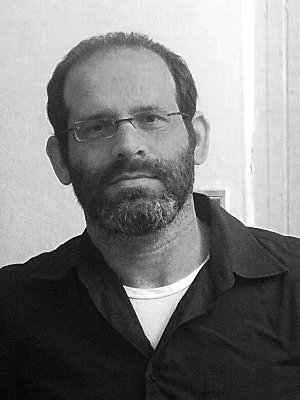
Dror Yinon teaches at the program for Hermeneutics and Cultural Studies at Bar-Ilan University. His main research fields are continental philosophy (mainly existentialism and post-structuralism), critical theory, and political philosophy.